Baking with Wholemeal Flour: How to Adjust Hydration and Rise
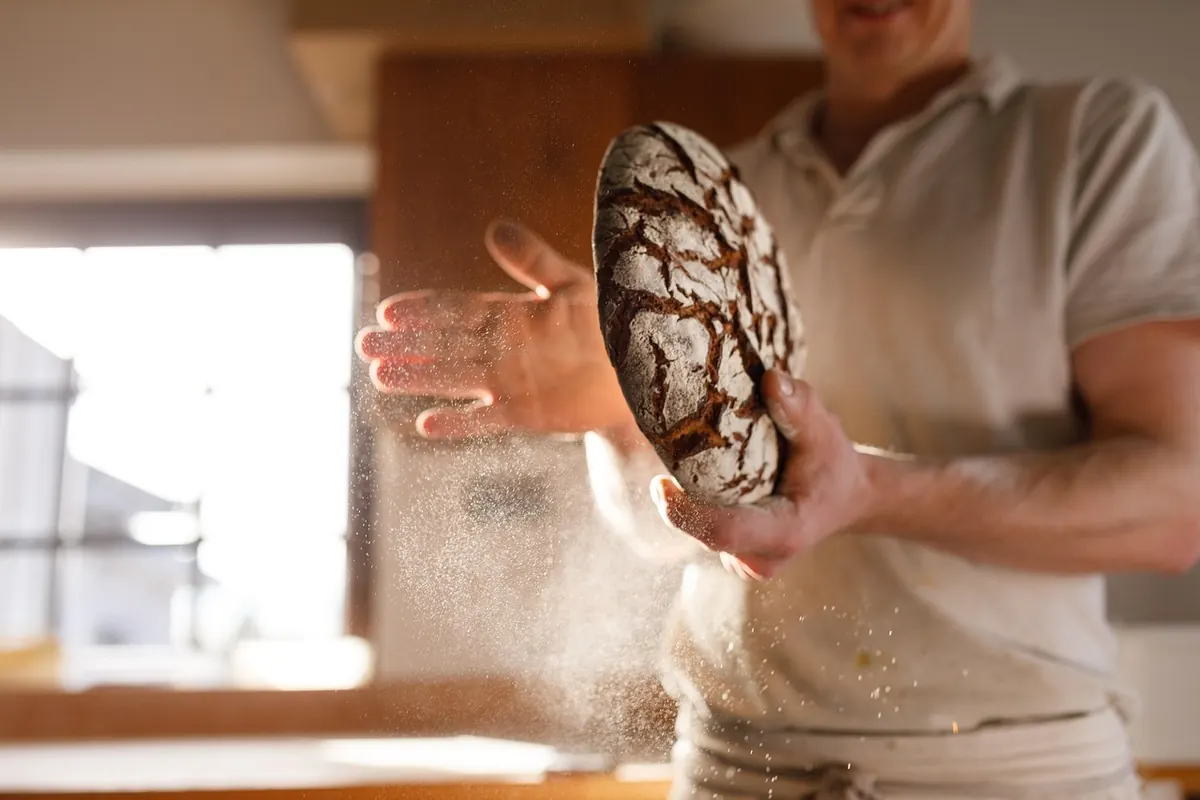
The first wholemeal loaf most of us bake looks fine on the cooling rack and then slices like a paving slab. The flour is not to blame. Wholemeal simply asks for different numbers: more water, gentler handling and a faster rise than the white-flour recipe you borrowed the method from. Change those three things and the same flour gives you a nutty, wheaty loaf that stands up to butter and cheese.
What Wholemeal Does to Your Dough
Wholemeal is the whole kernel ground up — starchy endosperm, the bran that surrounded it, and the oily germ. White flour keeps only the endosperm, and that difference explains most of what goes wrong.
Bran is thirsty and abrasive. It soaks up water that would otherwise hydrate your gluten, and its edges cut through gluten strands as the dough is worked. The germ brings fat and enzymes, which feed yeast quickly and keep breaking starch into sugars.
Two consequences follow. A wholemeal dough starts stiff and finishes slack, because bran drinks slowly — the dough you judge at minute five is not the dough you shape two hours later. And the gluten network that does form is weaker and more ragged than a white dough's at the same stage. It will stretch, just not as far.
Consider a dough made with 1000g of flour. In a white loaf, most of the water goes to the gluten. In a wholemeal loaf, the bran claims its share first, so the gluten has to wait. That is why the same recipe can feel dry when you mix it and almost too soft an hour later. Freshly milled wholemeal is especially thirsty because the bran and germ have not had time to settle or dry out. Commercial wholemeal varies too: fine stoneground flour hydrates more evenly, while coarse bran needs a soak before it will behave.
Wholemeal dough is not a white dough with brown flour. It is a different dough with a different timetable.
Add More Water, and Add It Early
A good rule: wholemeal wants roughly 5–10 percent more water than the same weight of white flour. If your white sandwich loaf sits at 65 percent hydration — 650g water to 1000g flour — start a 100 percent wholemeal version at 72–76 percent, and expect to go higher with coarsely ground or freshly milled grain. These are baker's percentages, where flour is always 100.
If you are blending flours, work out the average. A loaf made with 500g white flour at 65 percent hydration and 500g wholemeal at 75 percent needs about 70 percent overall, or 700g water for 1000g flour. That middle ground is often the easiest place to begin.
Two techniques make that extra water easier to handle.
- Autolyse. Mix flour and water alone, cover, and leave for 30–60 minutes before adding salt and yeast. The bran softens, the gluten starts to organise itself, and the dough turns noticeably more extensible.
- Soak coarse bran. If you sift bran out to lighten the crumb, pour boiling water over it, let it cool, then fold it back in later. Softened bran no longer tears at the dough.
- Hold back water. Reserve about 5 percent of the total water and add it after the autolyse if the dough feels stiff. This keeps you from tipping straight into a soupy mix.
Judge hydration by feel as well as by the scale. A wholemeal dough should be tacky but not soupy, clear the sides of the bowl, and pull a thin, translucent window when stretched. A ragged tear means it needs a rest, not more flour.
Knead Less, Fold More
Long machine kneading is wasted on wholemeal. You cannot beat bran into submission, and ten extra minutes in the mixer mostly warms the dough. Give it six to eight minutes on low speed to bring everything together, then switch to stretch and folds.
Every 30–45 minutes during the bulk rise, wet your hands, lift one side of the dough, stretch it upward and fold it over the middle. Turn the bowl a quarter and repeat three times. Three or four sets is plenty. Folds build strength without punishing the gluten, and they distribute bran evenly, so no pocket of the loaf turns out dry.
If you sifted bran and soaked it separately, add it during the second set of folds. The dough will look messy for a minute, then come back together. If the dough fights back at any point, cover it and walk away for ten minutes. Rest does more for wholemeal than force.
Proving Moves Faster Than You Expect
Wholemeal ferments more quickly than white. There is more food for the yeast in the bran and germ, and more wild yeast riding along on the flour. Recipes written for white flour often need 20–30 percent less bulk time, and sometimes more than that in a warm kitchen. A dough that would take two hours in white flour may be ready in 75–90 minutes as wholemeal. Temperature matters as much as the flour: at 24°C, bulk might take 90 minutes; at 28°C, it can be closer to an hour.
How to Tell Bulk Is Done
- The dough is 50–75 percent larger, domed and jiggly, with bubbles around the edge of the bowl.
- A finger pressed into the dough leaves a slow-filling indentation. If it springs back immediately, give it more time. If the dent stays, it is likely overproofed.
- The surface looks alive, with small blisters, and the dough pulls away from the bowl cleanly.
- The smell is yeasty and slightly sweet, not sharply alcoholic or sour.
If the dough is overproofed, do not throw it out. Shape it gently, give it a much shorter final proof, or press it into a tin and bake it as a flatbread-style loaf. If it is underproofed, wait another 15 minutes and check again.
Shaping, Final Proof and Baking
Wholemeal dough is more fragile than white, so handle it with confidence but without roughness. Turn it onto a lightly floured bench, pre-shape gently, and let it rest for 15–20 minutes. Then shape it firmly enough to create tension on the top. A pan loaf is forgiving because the tin supports the rise. For a freeform boule, use a well-floured banneton and place the dough seam-side up.
Final proof usually takes 45–75 minutes. Do not wait for it to double; a 50–70 percent rise is enough. Overproofed wholemeal collapses in the oven and turns gummy. Bake hot: 220–230°C for the first 15 minutes with steam if you can, then lower to 200°C until the crust is deep brown and the loaf sounds hollow. An instant-read thermometer should read 96–99°C in the centre. Cool completely before slicing. Wholemeal is especially gummy when cut warm.
A Starting Formula You Can Adjust
- 1000g wholemeal flour — or 500g wholemeal plus 500g white flour
- 720–760g water — 72–76 percent for all wholemeal; 68–72 percent for a blend
- 20g salt
- 10g instant yeast — or 200g active sourdough starter, with slightly less water
- Mix flour and water; autolyse for 30–60 minutes.
- Add salt and yeast; mix on low for 6–8 minutes, then fold 3–4 times during bulk.
- Bulk until 50–75 percent larger; shape; final proof for 45–75 minutes.
- Bake at 230°C with steam for 15 minutes, then at 200°C until deep brown and hollow-sounding.
Troubleshooting Wholemeal Loaves
- Dense and dry: usually not enough water, or bulk proof was too short. Add 5 percent more water next time and judge by dough feel, not the clock.
- Gummy centre: the loaf was cut hot or underbaked. Cool fully and aim for 96–99°C internally.
- Flat top: often overproofed. Shorten the final proof by 15 minutes on the next bake.
- Ragged tears on top: underproofed or shaped too tightly. Let the final proof go longer and handle the dough gently.
- Crumbly slices: too much bran and too little gluten strength. Blend in 20–30 percent white flour or add a tablespoon of vital wheat gluten per 500g flour.
Wholemeal rewards attention more than it rewards force. Give it more water early, build strength with folds instead of long kneading, and watch the rise rather than the recipe's timer. Do that, and the loaf on the cooling rack will slice cleanly, taste of wheat and toast, and disappear faster than the white bread beside it.
Photo: Intuitivmedia / Pixabay